Algeria
in Northern Africa
Africa
 Libya
Libya Mali
Mali Mauritania
 Morocco
 Niger
Niger Tunisia
 Western Sahara
- Currency and Currency Code:
- Dinar - DZD
- Spoken languages:
- Arabic
- Local electricity:
- 230 V - 50 Hz (plugs: C, F)
- Mobile phone / cellular frequencies (MHz):
- 900 MHz, 1800 MHz, 3G, 4G
- ISO 2-Letter code:
- DZ
- Internet top level domain:
- .dz
- Country phone prefix:
- +213
- Local Time (capital):
- Timezone:
- UTC/GMT offset: hours
Safety Score: 3,0 of 5.0 based on data from 9 authorites. Meaning we advice caution when travelling to Algeria.
Travel warnings are updated daily. Source: Travel Warning Algeria. Last Update: 2024-04-25 08:17:04
Explore Algeria
Algeria with its capital Algiers is located in Africa (Northern Africa, bordering the Mediterranean Sea). It covers some 2,381,741 square kilometers (slightly less than 3.5 times the size of Texas) with 40,969,400 citizens. Arabic is the language commonly spoken used in Algeria. Libya, Mali, Mauritania, Morocco, Niger, Tunisia and Western Sahara are bordering countries.
Algeria is an Arab and Berber country in North Africa. It has a mediterranean sea coastline in the north. Much of recent Algerian history has been dominated by civil wars and subsequent warlordism. That said, the country is gradually restoring order and will prove an interesting - if difficult - destination. The official language is Arabic. Generally, only the young generations in Algeria can understand some English, but most people are able to communicate in French. As in all of North Africa, the dominant religion in Algeria is Islam. Be respectful. If visiting a mosque, for example, be sure to be dressed conservatively and remove your shoes before entering it.
Popular Destinations in Algeria
Administrative regions of Algeria
- Adrar
- Ain Defla Province
- Ain Temouchent Province
- Algiers Province
- Annaba
- Batna
- Bechar Province
- Bejaia Province
- Biskra Province
- Blida Province
- Bouira Province
- Boumerdes Province
- Chlef Province
- Constantine Province
- Djelfa Province
- El Bayadh Province
- El Oued Province
- El Tarf Province
- Ghardaia Province
- Guelma Province
- Illizi Province
- Jijel Province
- Khenchela Province
- Laghouat Province
- M-Sila Province
- Mascara Province
- Medea Province
- Mila Province
- Mostaganem Province
- Naama Province
- Oran Province
- Ouargla Province
- Oum el Bouaghi Province
- Relizane Province
- Saida Province
- Setif Province
- Sidi Bel Abbes Province
- Skikda Province
- Souk Ahras Province
- Tamanrasset Province
- Tebessa Province
- Tiaret Province
- Tindouf Province
- Tipaza Province
- Tissemsilt Province
- Tizi Ouzou Province
- Tlemcen Province
- Wilaya de Bordj Bou Arreridj
About the country
Website: Algeria Tourism
2 Rue Smail Kerrar
16000 Alger
Algeria
Phone: +213 21 71 30 60
Fax: +213 21 71 30 59
Mail: ont@wissal.dz
The landscape is mostly high plateau and desert with some mountains as well as narrow, discontinuous coastal plain. The average density of population is about 17 per km². The climate in Algeria can be described as arid to semiaridmild, wet winters with hot, dry summers along coast, drier with cold winters and hot summers on high plateau, sirocco being a hot, dust/sand-laden wind especially common in summer. Potential threats by nature are droughts, mountainous areas subject to severe earthquakes and mudslides and floods in rainy season.
To reach someone Algeria dial +213 prior to a number. The local cellular networks are operated on 900 MHz, 1800 MHz, 3G, 4G. Websites typically end with the top level domain ".dz". If you want to bring electric appliances (e.g. battery chaarger), keep in min the local 230 V - 50 Hz (plugs: C, F). The sign for the locally used currency Dinar is DZD.
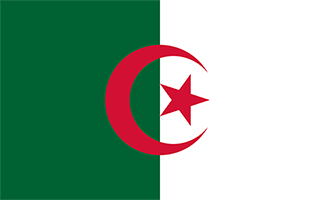
Two equal vertical bands of green (hoist side) and white; a red, 5-pointed star within a red crescent centered over the two-color boundary; the colors represent Islam (green), purity and peace (white), and liberty (red); the crescent and star are also Islamic symbols, but the crescent is more closed than those of other Muslim countries because Algerians believe the long crescent horns bring happiness.
After more than a century of rule by France, Algerians fought through much of the 1950s to achieve independence in 1962. Algeria's primary political party, the National Liberation Front (FLN), was established in 1954 as part of the struggle for independence and has since largely dominated politics. The Government of Algeria in 1988 instituted a multi-party system in response to public unrest, but the surprising first round success of the Islamic Salvation Front (FIS) in the December 1991 balloting led the Algerian army to intervene and postpone the second round of elections to prevent what the secular elite feared would be an extremist-led government from assuming power. The army began a crackdown on the FIS that spurred FIS supporters to begin attacking government targets. Fighting escalated into an insurgency, which saw intense violence from 1992-98, resulting in over 100,000 deaths - many attributed to indiscriminate massacres of villagers by extremists. The government gained the upper hand by the late-1990s, and FIS's armed wing, the Islamic Salvation Army, disbanded in January 2000. Abdelaziz BOUTEFLIKA, with the backing of the military, won the presidency in 1999 in an election widely viewed as fraudulent and won subsequent elections in 2004, 2009, and 2014. The government in 2011 introduced some political reforms in response to the Arab Spring, including lifting the 19-year-old state of emergency restrictions and increasing women's quotas for elected assemblies, while also increasing subsidies to the populace. Since 2014, Algeria’s reliance on hydrocarbon revenues to fund the government and finance the large subsidies for the population has fallen under stress because of declining oil prices.
Geography
| Area | ||
|---|---|---|
| Total (World Rank: 11) | 2,381,740 | sq km |
| Land (World Rank: 11) | 2,381,740 | sq km |
| Forest (World Rank: 4) | 79.63 | % |
| Comparative | slightly less than 3.5 times the size of Texas | |
| Coastline | ||
| 998 | ||
| Landborder | ||
| 6734 | ||
| Elevation | ||
| Lowest point (World Rank: 58) | -40 | m |
| Highest point (World Rank: 77) | 2,908 | m |
| Agricultural land | ||
| Total (World Rank: 174) | 17.40 | % |
| Arable (World Rank: 64) | 18.02 | % |
| Permanent crops (World Rank: 81) | 2.34 | % |
| Permanent pastures (World Rank: 4) | 79.63 | % |
| Irrigated land (World Rank: 40) | 13,600 | sq km |
| Map reference | ||
| Africa | ||
| Environment | ||
| Issues |
| |
| Agreement party |
| |
| Hazzards |
| |
| Location | ||
| Northern Africa, bordering the Mediterranean Sea, between Morocco and Tunisia | ||
| Climate | ||
| arid to semiarid; mild, wet winters with hot, dry summers along coast; drier with cold winters and hot summers on high plateau; sirocco is a hot, dust/sand-laden wind especially common in summer | ||
| Terrain | ||
| mostly high plateau and desert; some mountains; narrow, discontinuous coastal plain | ||
People
| Population | ||
|---|---|---|
| Total (World Rank: 33) | 40,969,400 | |
| Deathrate (World Rank: 204) | 0.43 | % |
| Birthrate (World Rank: 69) | 2.22 | % |
| Growthrate (World Rank: 62) | 1.70 | % |
| Migration rate (World Rank: 103) | -0.09 | % |
| Fertility rate (World Rank: 65) | 2.70 | % |
| Median age | ||
| Male (World Rank: 133) | 27.80 | |
| Female (World Rank: 133) | 28.40 | |
| Age structure | ||
| 0 14 male (World Rank: 29) | 6,148,570 | |
| 0 14 female (World Rank: 30) | 5,858,920 | |
| 15 24 male (World Rank: 35) | 3,208,180 | |
| 15 24 female (World Rank: 35) | 3,061,180 | |
| 25 54 male (World Rank: 30) | 8,906,160 | |
| 25 54 female (World Rank: 31) | 8,682,890 | |
| 55 64 male (World Rank: 34) | 1,410,300 | |
| 55 64 female (World Rank: 37) | 1,378,280 | |
| 65 x male (World Rank: 37) | 1,079,220 | |
| 65 x female (World Rank: 42) | 1,235,740 | |
| Health | ||
| Infant mortality rate (World Rank: 82) | 1.96 | % |
| Life expectancy total (World Rank: 77) | 77 | years |
| Life expectancy female (World Rank: 102) | 78 | years |
| Life expectancy male (World Rank: 64) | 76 | years |
| Physicians per 1000 (World Rank: 104) | 1.19 | |
| Sanitation access total (World Rank: 105) | 87.60 | % |
| Obesity adult (World Rank: 38) | 27.40 | % |
| Drinking water access (World Rank: 154) | 83.60 | % |
Energy
| Electricity | ||
|---|---|---|
| Production (World Rank: 43) | 64,670,000,000 | kWh |
| Consumption (World Rank: 46) | 53,440,000,000 | kWh |
| Export (World Rank: 62) | 641,000,000 | kWh |
| Import (World Rank: 75) | 610,000,000 | kWh |
| Source fossil (World Rank: 42) | 97.90 | % |
| Source nuclear (World Rank: 141) | 1.60 | % |
| Source renew (World Rank: 126) | 1.50 | % |
| Crude oil | ||
| Production (World Rank: 18) | 1,348,000 | bbl / day |
| Exports (World Rank: 16) | 798,900 | bbl / day |
| Imports (World Rank: 79) | 5,880 | bbl / day |
| Proved reserves (World Rank: 16) | 12,200,000,000 | bbl |
| Refined products | ||
| Production (World Rank: 26) | 657,600 | bbl / day |
| Consumption (World Rank: 35) | 428,000 | bbl / day |
| Export (World Rank: 12) | 575,800 | bbl / day |
| Import (World Rank: 72) | 62,480 | bbl / day |
| Natural gas | ||
| Production (World Rank: 10) | 83,040,000,000 | m³ |
| Consumption (World Rank: 24) | 44,320,000,000 | m³ |
| Export (World Rank: 7) | 43,420,000,000 | m³ |
| Carbon footprint | ||
| 128000000 | ||
Nation
| Budget | ||
|---|---|---|
| Education (World Rank: 97) | 4 | % of GDP |
| Military (World Rank: 5) | 7 | % of GDP |
| Health (World Rank: 77) | 7 | % of GDP |
| Surplus (World Rank: 202) | -14 | % of GDP |
| National symbol | ||
| star and crescent | ||
| National colours | ||
| white | ||
| Adjective | ||
| Algerian | ||
| Noun | ||
| Algerian(s) | ||
| Background | ||
| After more than a century of rule by France, Algerians fought through much of the 1950s to achieve independence in 1962. Algeria's primary political party, the National Liberation Front (FLN), was established in 1954 as part of the struggle for independence and has since largely dominated politics. The Government of Algeria in 1988 instituted a multi-party system in response to public unrest, but the surprising first round success of the Islamic Salvation Front (FIS) in the December 1991 balloting led the Algerian army to intervene and postpone the second round of elections to prevent what the secular elite feared would be an extremist-led government from assuming power. The army began a crackdown on the FIS that spurred FIS supporters to begin attacking government targets. Fighting escalated into an insurgency, which saw intense violence from 1992-98, resulting in over 100,000 deaths - many attributed to indiscriminate massacres of villagers by extremists. The government gained the upper hand by the late-1990s, and FIS's armed wing, the Islamic Salvation Army, disbanded in January 2000. Abdelaziz BOUTEFLIKA, with the backing of the military, won the presidency in 1999 in an election widely viewed as fraudulent and won subsequent elections in 2004, 2009, and 2014. The government in 2011 introduced some political reforms in response to the Arab Spring, including lifting the 19-year-old state of emergency restrictions and increasing women's quotas for elected assemblies, while also increasing subsidies to the populace. Since 2014, Algeria’s reliance on hydrocarbon revenues to fund the government and finance the large subsidies for the population has fallen under stress because of declining oil prices. | ||
| Flag description | ||
| two equal vertical bands of green (hoist side) and white; a red, 5-pointed star within a red crescent centered over the two-color boundary; the colors represent Islam (green), purity and peace (white), and liberty (red); the crescent and star are also Islamic symbols, but the crescent is more closed than those of other Muslim countries because Algerians believe the long crescent horns bring happiness | ||
Economy
| Gdp | ||
|---|---|---|
| Purchasing power parity (World Rank: 35) | 609,600,000,000 | USD |
| Real growth rate (World Rank: 85) | 3.30 | % |
| Per capita purchasing power parity (World Rank: 106) | 15,000 | USD |
| Source agriculture (World Rank: 75) | 12.90 | % |
| Source industry (World Rank: 38) | 36.20 | % |
| Source service (World Rank: 172) | 50.90 | % |
| Labourforce | ||
| Total (World Rank: 46) | 12,120,000 | |
| In poverty (World Rank: 88) | 23.00 | % |
| Products | ||
| Industries |
| |
| Agriculture |
| |
| Exports |
| |
| Imports |
| |
Communication
| Phone | ||
|---|---|---|
| Landline total (World Rank: 45) | 3,404,710 | |
| Landline per 100 (World Rank: 142) | 8.00 | |
| Mobile per 100 (World Rank: 74) | 120.00 | |
| Assessment | 0 | |
| Internet | ||
| Users (World Rank: 36) | 17,291,500 | |
| Population (World Rank: 136) | 42.90 | % |
Transport
| Air | ||
|---|---|---|
| Airports paved (World Rank: 38) | 64.00 | |
| Airports unpaved (World Rank: 36) | 93.00 | |
| Heliports (World Rank: 42) | 3.00 | |
| Rail | ||
| Total length (World Rank: 47) | 3,973 | |
| Road | ||
| Total length (World Rank: 43) | 113,655 | |
| Paved length (World Rank: 30) | 87,605 | |
| Unpaved length (World Rank: 58) | 26,050 | |
This is a list of famous places in this country in alphabetical order.
 'Ain el Turk
- Adrar
- Aflou
- Ain Beida
- Ain Defla
- Ain Oussera
- Ain Sefra
- Ain Temouchent
- Akbou
- Algiers
- Annaba
- Aoulef
- Bab Ezzouar
- Baraki
- Barika
- Batna
- Bechar
- Bejaia
- Beni Saf
- Berriane
- Berrouaghia
- Birine
- Birkhadem
- Biskra
- Blida
- Bordj Bou Arreridj
- Bordj el Kiffan
- Boufarik
- Bouira
- Boumerdas
- Chelghoum el Aid
- Chlef
- Constantine
- Dar el Beida
- Djelfa
- Draa Ben Khedda
- Ech Chettia
- El Affroun
- El Attaf
- El Bayadh
- El Eulma
- El Kala
- El Khroub
- El Kseur
- El Oued
- El Tarf
- Frenda
- Ghardaia
- Guelma
- Hammam Bou Hadjar
- Illizi
- Jijel
- Khemis Miliana
- Khemis el Khechna
- Khenchela
- Ksar Chellala
- Ksar el Boukhari
- L'Arbaa Nait Irathen
- Laghouat
- Larbaa
- M'Sila
- Mansoura
- Mascara
- Medea
- Meftah
- Messaad
- Metlili Chaamba
- Mila
- Mostaganem
- Naama
- Oran
- Ouargla
- Oued Rhiou
- Oum el Bouaghi
- Ras el Aioun
- Ras el Oued
- Reggane
- Relizane
- Remchi
- Rouissat
- Saida
- Setif
- Sidi Bel Abbes
- Sig
- Skikda
- Sougueur
- Souk Ahras
- Sour el Ghozlane
- Tamanrasset
- Tazoult-Lambese
- Tebessa
- Tiaret
- Timimoun
- Tindouf
- Tipasa
- Tissemsilt
- Tizi Ouzou
- Tlemcen
- Touggourt
- `Ain el Hadjel