Afghanistan
in Southern Asia
Asia
 China
China Iran
Iran Pakistan
 Tajikistan
 Turkmenistan
 Uzbekistan
- Currency and Currency Code:
- Afghani - AFN
- Spoken languages:
- Persian, Pushto, Uzbek, Turkmen
- Local electricity:
- 220 V - 50 Hz (plugs: C, F)
- Mobile phone / cellular frequencies (MHz):
- 900 MHz, 1800 MHz, 3G, 4G
- ISO 2-Letter code:
- AF
- Internet top level domain:
- .af
- Country phone prefix:
- +93
- Local Time (capital):
- Timezone:
- UTC/GMT offset: hours
Safety Score: 5,0 of 5.0 based on data from 9 authorites. Meaning it is not safe to travel Afghanistan.
Travel warnings are updated daily. Source: Travel Warning Afghanistan. Last Update: 2024-04-18 08:12:24
Explore Afghanistan
Afghanistan with its capital Kabul is located in Asia (Southern Asia, north and west of Pakistan). It covers some 652,231 square kilometers (almost six times the size of Virginia) with 34,124,800 citizens. Persian, Pushto, Uzbek and Turkmen are the common languages used in Afghanistan (consider regional differences). China, Iran, Pakistan, Tajikistan, Turkmenistan and Uzbekistan are bordering countries.
Afghanistan is a landlocked country in the heart of Asia. Traveling in Afghanistan is potentially very dangerous. It has spent the last 3 decades in the news for all the wrong reasons. While visiting has not been advisable for several years, it has much to offer. That said, even the adventurous should consider looking elsewhere for thrill-seeking at the moment. The most pleasant weather in Kabul is during April, May and September.
Popular Destinations in Afghanistan
Administrative regions of Afghanistan
- Badakhshan
- Badghis
- Baghlan
- Balkh
- Bamyan
- Daykundi Province
- Farah
- Faryab Province
- Ghazni
- Ghowr
- Helmand
- Herat
- Jowzjan
- Kabul
- Kandahar
- Kapisa
- Khowst
- Kunar
- Kunduz
- Laghman
- Logar
- Nangarhar
- Nimroz
- Nuristan
- Oruzgan
- Paktika
- Panjshir
- Parwan
- Samangan
- Sar-e Pul
- Takhar
- Wardak
- Wilayat-e Paktiya
- Wilayat-e Zabul
About the country
The topography is mostly rugged mountains with plains in north and southwest. The average density of population is about 52 per km². The climate in Afghanistan can be described as arid to semiarid with cold winters and hot summers. Potential natural disasters are damaging earthquakes occur in Hindu Kush mountains, droughts and flooding.
To reach someone Afghanistan dial +93 prior to a number. The local cellular networks are operated on 900 MHz, 1800 MHz, 3G, 4G. Websites typically end with the top level domain ".af". If you want to bring electric appliances (e.g. battery chaarger), keep in min the local 220 V - 50 Hz (plugs: C, F). The sign for the locally used currency Afghani is AFN.
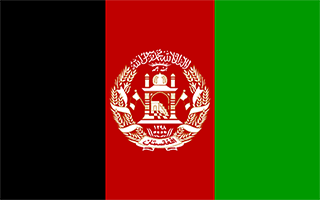
Three equal vertical bands of black (hoist side), red, and green, with the national emblem in white centered on the red band and slightly overlapping the other 2 bands; the center of the emblem features a mosque with pulpit and flags on either side, below the mosque are numerals for the solar year 1298 (1919 in the Gregorian calendar, the year of Afghan independence from the UK); this central image is circled by a border consisting of sheaves of wheat on the left and right, in the upper-center is an Arabic inscription of the Shahada (Muslim creed) below which are rays of the rising sun over the Takbir (Arabic expression meaning "God is great"), and at bottom center is a scroll bearing the name Afghanistan; black signifies the past, red is for the blood shed for independence, and green can represent either hope for the future, agricultural prosperity, or Islam.
Ahmad Shah DURRANI unified the Pashtun tribes and founded Afghanistan in 1747. The country served as a buffer between the British and Russian Empires until it won independence from notional British control in 1919. A brief experiment in democracy ended in a 1973 coup and a 1978 communist countercoup. The Soviet Union invaded in 1979 to support the tottering Afghan communist regime, touching off a long and destructive war. The USSR withdrew in 1989 under relentless pressure by internationally supported anti-communist mujahidin rebels. A series of subsequent civil wars saw Kabul finally fall in 1996 to the Taliban, a hardline Pakistani-sponsored movement that emerged in 1994 to end the country's civil war and anarchy. Following the 11 September 2001 terrorist attacks, a US, Allied, and anti-Taliban Northern Alliance military action toppled the Taliban for sheltering Usama BIN LADIN. A UN-sponsored Bonn Conference in 2001 established a process for political reconstruction that included the adoption of a new constitution, a presidential election in 2004, and National Assembly elections in 2005. In December 2004, Hamid KARZAI became the first democratically elected president of Afghanistan, and the National Assembly was inaugurated the following December. KARZAI was reelected in August 2009 for a second term. The 2014 presidential election was the country's first to include a runoff, which featured the top two vote-getters from the first round, Abdullah ABDULLAH and Ashraf GHANI. Throughout the summer of 2014, their campaigns disputed the results and traded accusations of fraud, leading to a US-led diplomatic intervention that included a full vote audit as well as political negotiations between the two camps. In September 2014, GHANI and ABDULLAH agreed to form the Government of National Unity, with GHANI inaugurated as president and ABDULLAH elevated to the newly-created position of chief executive officer. The day after the inauguration, the GHANI administration signed the US-Afghan Bilateral Security Agreement and NATO Status of Forces Agreement, which provide the legal basis for the post-2014 international military presence in Afghanistan. Despite gains toward building a stable central government, the Taliban remains a serious challenge for the Afghan Government in almost every province. The Taliban still considers itself the rightful government of Afghanistan, and it remains a capable and confident insurgent force despite its last two spiritual leaders being killed; it continues to declare that it will pursue a peace deal with Kabul only after foreign military forces depart.
Geography
| Area | ||
|---|---|---|
| Total (World Rank: 42) | 652,230 | sq km |
| Land (World Rank: 41) | 652,230 | sq km |
| Forest (World Rank: 6) | 79.00 | % |
| Comparative | almost six times the size of Virginia; slightly smaller than Texas | |
| Landborder | ||
| 5987 | ||
| Elevation | ||
| Lowest point (World Rank: 15) | 258 | m |
| Highest point (World Rank: 7) | 7,492 | m |
| Agricultural land | ||
| Total (World Rank: 49) | 58.07 | % |
| Arable (World Rank: 54) | 20.50 | % |
| Permanent crops (World Rank: 156) | 0.37 | % |
| Permanent pastures (World Rank: 6) | 79.00 | % |
| Irrigated land (World Rank: 19) | 32,080 | sq km |
| Map reference | ||
| Asia | ||
| Environment | ||
| Issues |
| |
| Agreement party |
| |
| Agreement signed |
| |
| Hazzards |
| |
| Location | ||
| Southern Asia, north and west of Pakistan, east of Iran | ||
| Climate | ||
| arid to semiarid; cold winters and hot summers | ||
| Terrain | ||
| mostly rugged mountains; plains in north and southwest | ||
People
| Population | ||
|---|---|---|
| Total (World Rank: 39) | 34,124,800 | |
| Deathrate (World Rank: 10) | 1.34 | % |
| Birthrate (World Rank: 12) | 3.79 | % |
| Growthrate (World Rank: 31) | 2.36 | % |
| Migration rate (World Rank: 104) | -0.09 | % |
| Fertility rate (World Rank: 10) | 5.12 | % |
| Median age | ||
| Male (World Rank: 199) | 18.80 | |
| Female (World Rank: 204) | 18.90 | |
| Age structure | ||
| 0 14 male (World Rank: 26) | 7,093,980 | |
| 0 14 female (World Rank: 27) | 6,869,740 | |
| 15 24 male (World Rank: 30) | 3,859,700 | |
| 15 24 female (World Rank: 30) | 3,723,680 | |
| 25 54 male (World Rank: 46) | 5,273,970 | |
| 25 54 female (World Rank: 48) | 5,082,970 | |
| 55 64 male (World Rank: 56) | 659,635 | |
| 55 64 female (World Rank: 60) | 678,942 | |
| 65 x male (World Rank: 73) | 407,437 | |
| 65 x female (World Rank: 76) | 474,764 | |
| Health | ||
| Infant mortality rate (World Rank: 1) | 11.06 | % |
| Life expectancy total (World Rank: 219) | 52 | years |
| Life expectancy female (World Rank: 216) | 53 | years |
| Life expectancy male (World Rank: 219) | 50 | years |
| Physicians per 1000 (World Rank: 141) | 0.30 | |
| Hospital bed per 1000 (World Rank: 173) | 0.50 | |
| Sanitation access total (World Rank: 178) | 31.90 | % |
| Obesity adult (World Rank: 176) | 5.50 | % |
| Drinking water access (World Rank: 196) | 55.30 | % |
Energy
| Electricity | ||
|---|---|---|
| Production (World Rank: 147) | 1,034,000,000 | kWh |
| Consumption (World Rank: 122) | 4,741,000,000 | kWh |
| Import (World Rank: 47) | 3,779,000,000 | kWh |
| Source fossil (World Rank: 160) | 44.70 | % |
| Source nuclear (World Rank: 32) | 55.10 | % |
| Source renew (World Rank: 154) | 0.20 | % |
| Refined products | ||
| Consumption (World Rank: 74) | 130,000 | bbl / day |
| Import (World Rank: 49) | 127,200 | bbl / day |
| Natural gas | ||
| Production (World Rank: 76) | 189,000,000 | m³ |
| Consumption (World Rank: 102) | 816,000,000 | m³ |
| Carbon footprint | ||
| 7400000 | ||
Nation
| Budget | ||
|---|---|---|
| Education (World Rank: 124) | 3 | % of GDP |
| Military (World Rank: 124) | 1 | % of GDP |
| Health (World Rank: 52) | 8 | % of GDP |
| Surplus (World Rank: 210) | -25 | % of GDP |
| National symbol | ||
| lion | ||
| National colours | ||
| red | ||
| Adjective | ||
| Afghan | ||
| Noun | ||
| Afghan(s) | ||
| Background | ||
| Ahmad Shah DURRANI unified the Pashtun tribes and founded Afghanistan in 1747. The country served as a buffer between the British and Russian Empires until it won independence from notional British control in 1919. A brief experiment in democracy ended in a 1973 coup and a 1978 communist countercoup. The Soviet Union invaded in 1979 to support the tottering Afghan communist regime, touching off a long and destructive war. The USSR withdrew in 1989 under relentless pressure by internationally supported anti-communist mujahidin rebels. A series of subsequent civil wars saw Kabul finally fall in 1996 to the Taliban, a hardline Pakistani-sponsored movement that emerged in 1994 to end the country's civil war and anarchy. Following the 11 September 2001 terrorist attacks, a US, Allied, and anti-Taliban Northern Alliance military action toppled the Taliban for sheltering Usama BIN LADIN. A UN-sponsored Bonn Conference in 2001 established a process for political reconstruction that included the adoption of a new constitution, a presidential election in 2004, and National Assembly elections in 2005. In December 2004, Hamid KARZAI became the first democratically elected president of Afghanistan, and the National Assembly was inaugurated the following December. KARZAI was reelected in August 2009 for a second term. The 2014 presidential election was the country's first to include a runoff, which featured the top two vote-getters from the first round, Abdullah ABDULLAH and Ashraf GHANI. Throughout the summer of 2014, their campaigns disputed the results and traded accusations of fraud, leading to a US-led diplomatic intervention that included a full vote audit as well as political negotiations between the two camps. In September 2014, GHANI and ABDULLAH agreed to form the Government of National Unity, with GHANI inaugurated as president and ABDULLAH elevated to the newly-created position of chief executive officer. The day after the inauguration, the GHANI administration signed the US-Afghan Bilateral Security Agreement and NATO Status of Forces Agreement, which provide the legal basis for the post-2014 international military presence in Afghanistan. Despite gains toward building a stable central government, the Taliban remains a serious challenge for the Afghan Government in almost every province. The Taliban still considers itself the rightful government of Afghanistan, and it remains a capable and confident insurgent force despite its last two spiritual leaders being killed; it continues to declare that it will pursue a peace deal with Kabul only after foreign military forces depart. | ||
| Flag description | ||
| three equal vertical bands of black (hoist side), red, and green, with the national emblem in white centered on the red band and slightly overlapping the other 2 bands; the center of the emblem features a mosque with pulpit and flags on either side, below the mosque are numerals for the solar year 1298 (1919 in the Gregorian calendar, the year of Afghan independence from the UK); this central image is circled by a border consisting of sheaves of wheat on the left and right, in the upper-center is an Arabic inscription of the Shahada (Muslim creed) below which are rays of the rising sun over the Takbir (Arabic expression meaning "God is great"), and at bottom center is a scroll bearing the name Afghanistan; black signifies the past, red is for the blood shed for independence, and green can represent either hope for the future, agricultural prosperity, or Islam | ||
Economy
| Gdp | ||
|---|---|---|
| Purchasing power parity (World Rank: 98) | 66,650,000,000 | USD |
| Real growth rate (World Rank: 118) | 2.40 | % |
| Per capita purchasing power parity (World Rank: 203) | 2,000 | USD |
| Source agriculture (World Rank: 40) | 22.00 | % |
| Source industry (World Rank: 132) | 22.00 | % |
| Source service (World Rank: 145) | 56.00 | % |
| Labourforce | ||
| Total (World Rank: 60) | 7,983,000 | |
| In poverty (World Rank: 47) | 35.80 | % |
| Products | ||
| Industries |
| |
| Agriculture |
| |
| Exports |
| |
| Imports |
| |
Communication
| Phone | ||
|---|---|---|
| Landline total (World Rank: 138) | 114,192 | |
| Landline per 100 (World Rank: 197) | 1.00 | |
| Mobile per 100 (World Rank: 189) | 65.00 | |
| Assessment | 0 | |
| Internet | ||
| Users (World Rank: 91) | 3,531,770 | |
| Population (World Rank: 208) | 10.60 | % |
Transport
| Air | ||
|---|---|---|
| Airports paved (World Rank: 69) | 25.00 | |
| Airports unpaved (World Rank: 111) | 18.00 | |
| Heliports (World Rank: 26) | 9.00 | |
| Road | ||
| Total length (World Rank: 86) | 42,150 | |
| Paved length (World Rank: 71) | 12,350 | |
| Unpaved length (World Rank: 53) | 29,800 | |
| Water | ||
| Total length (World Rank: 61) | 1,200 | |
This is a list of famous places in this country in alphabetical order.
 Aibak
Aibak- Anar Darah
- Andkhoy
- Art Khwajah
- Asadabad
- Ashkasham
- Asmar
- Bagh-e Maidan
- Baghlan
- Balkh
- Bamyan
- Baraki Barak
- Basawul
- Bazarak
- Chahar Burj
- Charikar
- Chiras
- Darzab
- Dasht-e Archi
- Farah
- Farkhar
- Fayroz Koh
- Fayzabad
- Gardez
- Gereshk
- Ghazni
- Ghormach
- Ghulam `Ali
- Herat
- Hukumati Azrah
- Hukumati Dahanah-ye Ghori
- Imam Sahib
- Jabal Saraj
- Jalalabad
- Jurm
- Kabul
- Kafir Qala
- Kandahar
- Karukh
- Khanabad
- Khandud
- Khash
- Khost
- Khulm
- Kotah-ye Sangi
- Kuhsan
- Kunduz
- Kushk
- Larkird
- Lashkar Gah
- Markaz-e Hukumat-e Darweshan
- Markaz-e Woluswali-ye Achin
- Maydanshakhr
- Maymana
- Mazar-e Sharif
- Mehtar Lam
- Mir Bachah Kot
- Mirabad
- Mulkanah
- Nahrin
- Nurgal
- Paghman
- Panjab
- Parun
- Pul-e Khumri
- Pul-e `Alam
- Qal`ah-ye Shahr
- Qala i Naw
- Qalat
- Qarah Bagh
- Qarawul
- Qarchi Gak
- Qarqin
- Rudbar
- Rustaq
- Sang-e Charak
- Sangin
- Sar-e Pul
- Sarobi
- Shahrak
- Sharan
- Shibirghan
- Shindand
- Sidqabad
- Tagab
- Tagaw-Bay
- Taloqan
- Tarinkot
- Tir Pul
- Tukzar
- Urgun
- Uruzgan
- Yangi Qal`ah
- Zarah Sharan
- Zaranj
- Zarghun Shahr
- Zindah Jan
- Zorkot
- Zurmat
- `Alaqahdari Dishu